
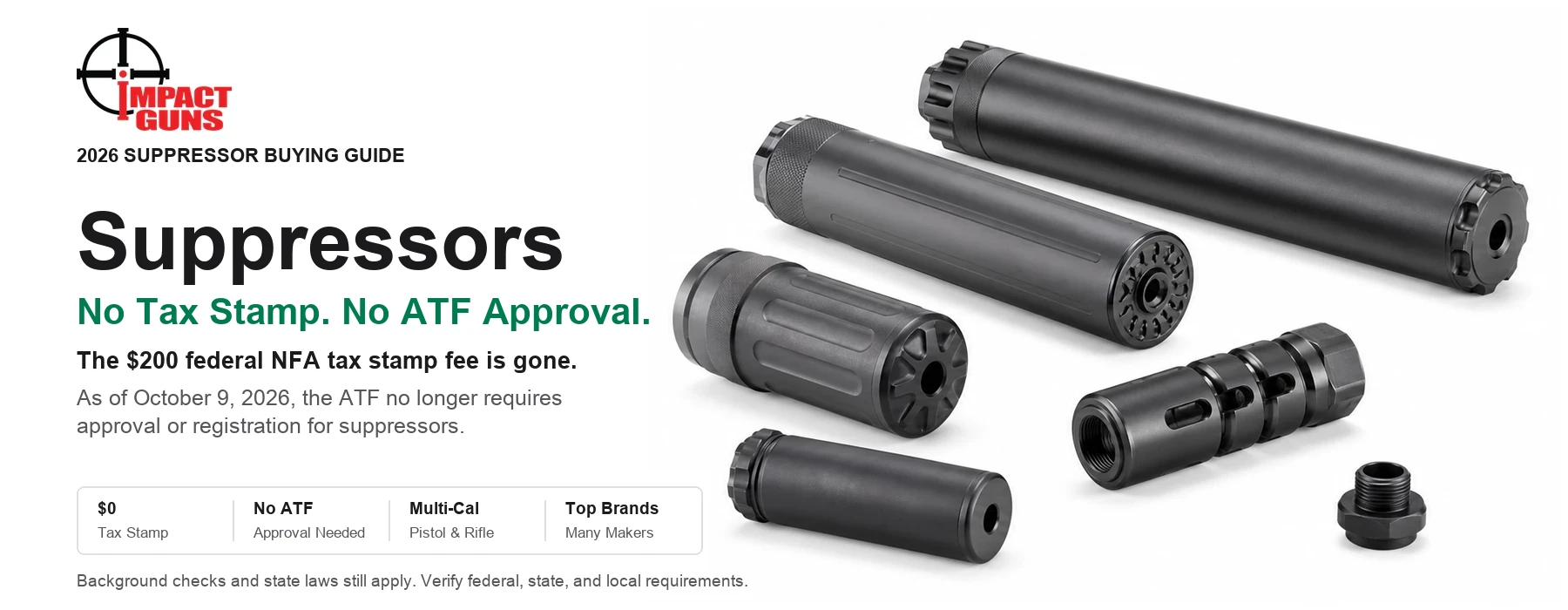
Suppressors
Suppressors changed in 2026. The $200 NFA tax is now $0, and on October 9, 2026 the ATF announced it no longer requires its approval or registration for suppressors. You still pass a background check, and your state must allow suppressors. Impact Guns stocks suppressors for pistols, rifles, and shotguns from manufacturers including SilencerCo, Dead Air Armament, Rugged Suppressors, Gemtech, SureFire, and Q LLC. Talk to your dealer before you order so you both know the current steps.
Find a cover for your new suppressor here: Suppressor Covers
Read our full Suppressor Buying Guide ↓
What Changed in 2026: No Tax Stamp, No ATF Approval
For decades, every suppressor transfer required a $200 NFA tax stamp paid to the ATF. Congress cut that tax to $0 in a law signed in July 2025, effective January 1, 2026. On October 9, 2026, the ATF published an open letter saying it no longer requires its approval or registration for suppressors. The ATF still accepts the old forms on a voluntary basis. Machine guns and destructive devices are not affected. For a plain-language summary, read our article ATF NFA Update: What Changes for Suppressors and SBRs.
How to Buy a Suppressor in 2026
You select your suppressor, order it, and complete the Form 4473 and a federal background check at pickup, just as you would for any firearm. Your dealer can tell you how long their process takes. Contact your dealer before you order, because these changes are new and dealers are still updating their process. For every step in detail, see our guide, How to Buy a Suppressor.
Do I Still Need to File a Form 4?
Not to meet an ATF approval requirement. The ATF says it will keep accepting Form 1, Form 3 and Form 4 applications on a voluntary basis, so filing is your choice. If you want advice, ask a qualified attorney.
Choosing the Right Suppressor: Caliber and Application
Suppressors are caliber-specific — a 9mm pistol suppressor won’t work on a 5.56 rifle. The key specs to match are the caliber rating, the thread pitch on your host firearm’s barrel, and the overall diameter (which affects whether the suppressor clears your handguard). Most modern suppressors are rated for multiple calibers — a .30 caliber suppressor can typically be used on .308, 6.5 Creedmoor, and other .30-cal platforms. For versatility, a multi-caliber suppressor or a direct-thread mount that works across your battery is the most practical starting point. Our staff can help match you to the right unit for your specific host firearms.
Pistol Suppressors: 9mm, .45 ACP, and More
Pistol suppressors reduce report to hearing-safe levels with subsonic ammunition and dramatically reduce muzzle blast and flash in defensive situations. The SilencerCo Osprey and Omega series, Dead Air Armament Ghost, and Rugged Suppressors Obsidian are among the most popular pistol options in our inventory. Most pistol cans are rated for 9mm and .45 ACP at minimum; many cover 5.7x28mm, 10mm, and other handgun calibers. Wet-shooting with a small amount of solvent or water further reduces sound levels for hearing-safe .22 LR use in many designs. Barrel threading is required on most pistols — verify your host is threaded or can be threaded before purchasing.
Rifle Suppressors: 5.56, .308, and Multi-Caliber
Rifle suppressors manage the significantly higher gas volumes of centerfire rifle cartridges and are rated for substantially higher pressures and temperatures than pistol cans. The Dead Air Armament Sandman series, SilencerCo Omega, and Griffin Armament Recce are strong options for 5.56 and .308 host firearms. Multi-caliber rifle suppressors offer maximum versatility — a single unit that covers your AR-15 in 5.56, your bolt-action in 6.5 Creedmoor, and your .308 semi-auto is often the most cost-effective solution for multi-gun households. Full-auto rated suppressors are required if you’re running a select-fire host.
Find a cover for your suppressor here: Suppressor Covers
State Restrictions: Where Suppressors Are Still Prohibited
The ATF change does not affect state law. Suppressors remain prohibited at the state level in California, Delaware, Hawaii, Illinois, Massachusetts, New Jersey, New York, Rhode Island, and Washington D.C. Residents of these states cannot legally purchase or possess suppressors regardless of federal changes. Most other states allow suppressor ownership, but local rules vary. Use our FFL dealer lookup to find a licensed dealer near you.
Frequently Asked Questions: Suppressors
Should I talk to my dealer first?
Yes. These changes are new, and your dealer may still be updating their process. Contact your dealer before you order. Ask which steps and forms they use, what fees they charge, and what your state allows.
How do I buy a suppressor in 2026?
The $200 NFA tax is now $0, and the ATF no longer requires approval or registration for suppressors. The process now is: (1) choose your suppressor, (2) order it and choose your dealer, (3) pass the Form 4473 and a federal background check, (4) take possession. See our full guide, How to Buy a Suppressor.
Is a suppressor worth it?
Yes for most regular shooters. Suppressors reduce muzzle blast to hearing-safe levels on most calibers with subsonic ammunition, allow conversation at the range without hearing protection, reduce neighbor complaints at rural properties, and make follow-up shots faster by reducing flinch. The elimination of the $200 tax stamp in 2026 removed the primary cost objection. A quality suppressor lasts a lifetime with proper maintenance.
What is the quietest suppressor?
The quietest suppressed configurations use subsonic ammunition (.300 Blackout subsonic, .45 ACP subsonic, or subsonic .22 LR) with a properly matched suppressor. .22 LR suppressed is the quietest common configuration — hearing safe even without ear protection in many setups. 9mm subsonic and .45 ACP suppressed are next. No suppressor makes a firearm "movie quiet" — the action cycling, bullet in flight, and supersonic crack (if using supersonic ammunition) all produce sound the suppressor cannot reduce.
Do suppressors fit all guns?
No — suppressors attach via threaded muzzle or quick-detach mount. Your firearm needs a threaded barrel (or a factory threaded configuration) in the correct thread pitch for the suppressor. Common thread pitches: 1/2x28 for 5.56 and 9mm, 5/8x24 for .308. Always verify compatibility between your suppressor and host firearm before purchase.
What states prohibit suppressors?
As of 2026, suppressors are prohibited for civilian ownership in California, Delaware, Hawaii, Illinois, Massachusetts, New Jersey, New York, and Rhode Island, plus Washington D.C. Most other states allow civilian suppressor ownership, but local rules vary. Always verify current state law before purchasing.
See Also: IWI Suppressors • .300 Blackout Ammo • 9mm Ammo • AR-15 Rifles • Pistol Caliber Carbines