
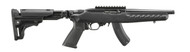
What Is an SBR? Short-Barreled Rifle Guide for 2026 | Impact Guns
Posted by Thomas on Jul 6th 2026
<p>A short-barreled rifle (SBR) is a rifle with a barrel under 16 inches or an overall length under 26 inches. As of January 1, 2026, the NFA tax stamp for SBRs was eliminated — making this one of the most important years in decades to understand what an SBR is, what the current rules are, and whether one makes sense for you.</p>
<h3>The Legal Definition</h3>
<p>Under the National Firearms Act, a short-barreled rifle is defined as a rifle with a barrel length under 16 inches OR an overall length under 26 inches. Prior to January 1, 2026, manufacturing, transferring, or possessing an SBR required a $200 tax stamp, registration with the ATF, and a months-long wait for Form 4 approval. As of January 1, 2026, the tax stamp requirement was eliminated. SBRs now require only a standard background check — the same process as buying any other firearm.</p>
<h3>What Changed in 2026</h3>
<p>The NFA tax stamp elimination is the most significant change to suppressor and SBR law in decades. Prior to 2026, the process looked like this: fill out ATF Form 1 (to make) or Form 4 (to transfer), pay $200, submit fingerprints and photos, and wait 6-12+ months for approval. As of January 1, 2026, that entire process is gone for SBRs and suppressors. You can now buy a factory SBR or convert a pistol to SBR configuration with only a background check. No forms. No wait. No tax.</p>
<h3>SBR vs. AR Pistol — What's the Difference Now?</h3>
<p>Before 2026, this distinction mattered enormously. An AR pistol with a brace was legally distinct from an SBR with a stock — the pistol required no NFA paperwork, the SBR required the full Form 4 process. That distinction is now largely moot for most buyers. With the tax stamp eliminated, converting a pistol to SBR configuration (adding a proper rifle stock) no longer requires ATF approval. The practical difference between an AR pistol and an SBR in 2026 is simply which configuration you prefer — a brace or a stock.</p>
<h3>Why Choose an SBR?</h3>
<p><strong>Maneuverability</strong> — A 10.5" or 11.5" barreled AR with a proper folding or collapsible stock is significantly easier to handle in vehicles, buildings, and tight spaces than a 16" rifle. This is the primary appeal for home defense, law enforcement, and military applications.</p>
<p><strong>Suppressor compatibility</strong> — Short barrels are naturally quieter with suppressors than longer barrels. An 8-10" .300 Blackout SBR with a suppressor running subsonic ammunition is one of the most hearing-safe rifle configurations available.</p>
<p><strong>Compactness with full stock</strong> — A pistol brace and a proper rifle stock handle very differently. A folding rifle stock on a short-barreled platform gives you the full handling benefit of a shouldered rifle in a compact package.</p>
<h3>Barrel Length and Ballistics</h3>
<p>Shorter barrels produce lower muzzle velocity. In 5.56 NATO, a 10.5" barrel produces roughly 200-300 fps less velocity than a 16" barrel — meaningful for longer-range shooting but negligible for home defense distances. In .300 Blackout with subsonic loads, barrel length matters very little since subsonic ammunition is already below the speed of sound regardless of barrel length. For most SBR applications, the velocity tradeoff is worth the handling benefits.</p>
<h3>Popular SBR Platforms</h3>
<p><strong>AR-15 based</strong> — The most common SBR platform. Available from nearly every major AR manufacturer including Daniel Defense, BCM, LWRC, Smith & Wesson (M&P15 AXE), and Sig Sauer. Typical SBR barrel lengths are 10.5", 11.5", and 14.5".</p>
<p><strong>.300 Blackout</strong> — Designed specifically for short barrels and suppressor use. A .300 Blackout SBR is one of the best suppressor host configurations available, especially with subsonic ammunition.</p>
<p><strong>AK platform</strong> — Short AKs in 7.62x39 or 5.45x39 are popular SBR configurations. The KRINKOV-style builds are classic examples.</p>
<p><strong>PCC (Pistol Caliber Carbines)</strong> — SBR versions of PCCs like the CZ Scorpion, B&T APC9, and similar platforms offer suppressor-friendly pistol caliber performance in a compact package.</p>
<h3>State Law Considerations</h3>
<p>Federal law now permits SBRs with only a background check, but state law still applies. Several states have stricter restrictions on SBRs than federal law. Always verify your state's specific laws before purchasing or converting an SBR. Your local FFL dealer can advise on state-specific requirements.</p>
<h3>FAQ</h3>
<p><strong>What is the minimum barrel length for a rifle without SBR classification?</strong><br>
16 inches. A rifle with a barrel of 16" or longer and overall length of 26" or longer is not classified as an SBR and requires no NFA paperwork.</p>
<p><strong>Do I still need to register an SBR in 2026?</strong><br>
The $200 tax stamp and ATF Form 4/Form 1 process was eliminated as of January 1, 2026. SBRs now require only a standard background check at the point of sale. However, some states have additional requirements — verify your state's laws before purchasing.</p>
<p><strong>Can I travel across state lines with an SBR?</strong><br>
Interstate travel with an SBR is permitted without ATF notification as of 2026, though you should verify current rules with your FFL or legal counsel as regulations can change.</p>
<p><strong>What is the best caliber for an SBR?</strong><br>
For suppressed use, .300 Blackout with subsonic loads is the top choice — it's designed specifically for short barrels and suppressor use. For general-purpose use, 5.56 NATO in a 10.5-11.5" barrel is the most common and versatile SBR configuration.</p>
<p><strong>Is an AR pistol the same as an SBR?</strong><br>
No, but the distinction matters less in 2026. An AR pistol has a brace (not a stock) and is not NFA-regulated. An SBR has a proper rifle stock and a barrel under 16". With the NFA tax stamp eliminated, converting an AR pistol to SBR configuration now only requires a background check rather than a months-long ATF approval process.</p>