
Ruger 10/22
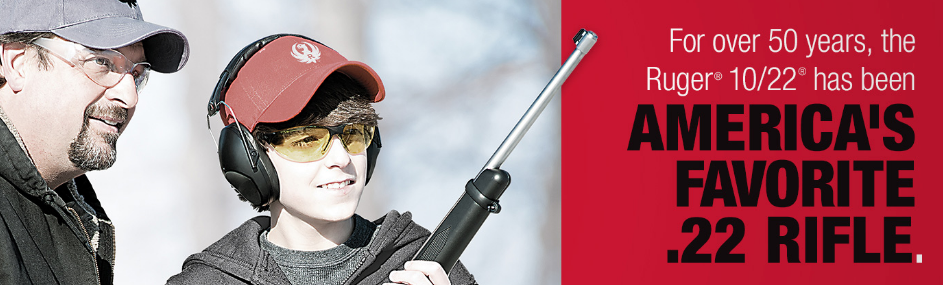
The Ruger 10/22 has been in continuous production since 1964 and remains the best-selling .22 LR semi-automatic rifle in America by a wide margin. With over 7 million produced and an aftermarket ecosystem that rivals the AR-15 in breadth, the 10/22 is simultaneously the perfect first rifle for new shooters and a platform that experienced shooters spend years and serious money building into precision target guns. From the factory Carbine model to the Takedown and Competition variants, there’s a 10/22 configuration for virtually every .22 LR application imaginable.
Read our full Ruger 10/22 Buying Guide ↓
The Model Lineup: Carbine, Takedown, Target, and Competition
The 10/22 Carbine is the original — 18.5” barrel, synthetic or hardwood stock, 10-round rotary magazine, and the fundamental reliability that has made the platform legendary. The Takedown splits the receiver from the barrel assembly for compact storage in a backpack or case, reassembling in seconds without tools — a genuinely practical design for hiking, camping, or travel. The Target model adds a hammer-forged heavy barrel and a more adjustable stock for bench shooting and small-bore competition. The Competition model goes further with a precision barrel, adjustable trigger, and thumbhole stock optimized for formal target work.
Ruger 10/22 — 2026 Factory Updates
For 2026 Ruger introduced several updates across the 10/22 lineup. The 10/22 Carbine now ships with an upgraded factory trigger group featuring a lighter reset and reduced take-up — a change long-requested by the competitive rimfire community. The 10/22 Takedown received a revised barrel locking mechanism that tightens return-to-battery repeatability after reassembly, addressing a common concern for shooters who break down the rifle frequently for transport. New color and stock configurations have also been added, including an OD Green synthetic Carbine and a revised Sporter profile in American walnut. All 2026 production 10/22s are compatible with existing BX-series magazines and the full range of aftermarket stocks, chassis, and accessories.
The 10/22 Aftermarket: The Other Reason to Buy One
The 10/22’s aftermarket is matched only by the AR-15 in depth and variety. Volquartsen, Kidd, and Timney produce drop-in trigger assemblies that transform the factory trigger into a match-grade unit. Hogue, Magpul, and dozens of others offer replacement stocks in every configuration from tactical to benchrest. Aftermarket barrels from Green Mountain and Volquartsen improve accuracy dramatically over the factory barrel. Extended magazines from Ruger BX-25 and aftermarket manufacturers push capacity to 25 or 50 rounds. A 10/22 purchased as a base platform can be incrementally built into a precision target rifle over years without ever buying a new firearm.
Training Value: Why the 10/22 Makes Every Shooter Better
The 10/22’s greatest underappreciated value is as a training platform. At a fraction of the cost of centerfire ammunition, shooters can run thousands of rounds of trigger control, sight alignment, and target transition drills that directly transfer to centerfire performance. The 10/22’s light recoil removes the flinch reflex from the training equation, letting shooters focus purely on technique. Many serious centerfire competitors run dedicated .22 training regimens specifically for this reason. For new shooters developing fundamentals, the 10/22 is the most economical path to building real skill.
10/22 for Youth and New Shooters
The 10/22 Carbine is the default recommendation for introducing young or new shooters to semi-automatic rifles. The low recoil, manageable noise, and familiar rifle ergonomics make it approachable without intimidation. The 18.5” barrel length is comfortable for most youth shooters, and the lightweight synthetic-stocked variants keep overall weight manageable. The 10-round factory magazine limits the pace of fire to something a new shooter can manage comfortably. Many shooters who started on a 10/22 decades ago still own and shoot the same gun today — a testament to how well the platform scales with a shooter’s development.
Suppressor Compatibility
The 10/22 is one of the most popular suppressor hosts in the rimfire category. With a threaded-barrel model or a barrel swap to an aftermarket threaded barrel, the 10/22 and a quality .22 suppressor produce genuinely quiet results with standard velocity ammunition. Subsonic .22 LR rounds combined with a suppressor and the 10/22’s semi-auto action create a hearing-safe shooting experience that’s difficult to replicate with any other platform at the price point. The Takedown model is particularly popular as a suppressed trail or camp gun given its compact transport size.
New for 2026: Carbon Fiber Takedown and Current Configurations
Ruger continues to expand the 10/22 lineup with new configurations that reflect the platform’s evolution beyond its classic walnut-and-blued origins. The 10/22 Takedown Carbon Fiber is the most distinctive recent addition — a Takedown-format 10/22 with a carbon fiber barrel shroud, Magpul Hunter X-22 Backpacker stock in textured white speckle black, and a 16.1” threaded carbon barrel that keeps the overall package weight exceptional for a rifle with this level of component quality. The BX-Trigger upgrade, which reduces pull weight to approximately 2.5 lbs from the standard 6 lb mil-spec pull, is now available as a factory option on select 10/22 configurations rather than requiring an aftermarket installation. For buyers who want the current production 10/22 with the most modern configuration, the Takedown with factory BX-Trigger and threaded barrel is the recommended starting point — suppressor-ready from the box and competition-capable without modification.
Related Pages at Impact Guns
See the full Ruger brand page for the full lineup including the Ruger Mark IV pistol. Browse all .22 rifles for comparisons. For rimfire ammunition see our .22 LR ammo page, and for optics to top your 10/22 see our scopes page.
Ruger 10/22 Upgrades: The World’s Most Customizable Rimfire
The Ruger 10/22 has the most extensive aftermarket ecosystem of any rimfire rifle in history — arguably more aftermarket support than any rifle platform except the AR-15. Every component of the 10/22 can be upgraded or replaced with aftermarket parts, from a drop-in trigger to a complete barrel, stock, and receiver swap that leaves only the serialized receiver as the original Ruger part. The upgrade path is a significant part of the 10/22’s appeal for competitive shooters and enthusiasts who want a highly personalized platform. Volquartsen is the gold standard for 10/22 aftermarket components, producing the A.R.T. (Accurizing & Reliability Treatment) Complete Trigger Pack — a drop-in trigger replacement that transforms the factory trigger into a competition-grade unit with a sub-2-pound pull, reduced reset, and dramatically improved accuracy potential. Kidd Innovative Design produces match-grade barrels and complete upper assemblies. Magpul, Hogue, and Boyds offer aftermarket stocks ranging from tactical chassis to traditional wood. BX-series factory magazines from Ruger are supplemented by aftermarket rotary and extended magazines for competition use. For shooters who want to build the ultimate suppressed .22 LR platform, the 10/22’s compatibility with threaded barrels and the availability of dedicated 10/22 suppressors from SilencerCo, Rugged, and others makes it the default starting point for any suppressed rimfire build.
Frequently Asked Questions
Why is the Ruger 10/22 so popular?
The Ruger 10/22 has been America's best-selling .22 LR rifle since its introduction in 1964 for several converging reasons: it is mechanically reliable, accurate, lightweight, and has the deepest aftermarket of any rimfire rifle in history — stocks, triggers, barrels, chassis, suppressors, and optics are available from hundreds of manufacturers. It is the default recommendation for a first rifle, a training companion for centerfire shooters, and a competition platform in its own right.
What can you do with a Ruger 10/22?
The 10/22 serves multiple roles: plinking and recreational shooting, small game hunting (squirrel, rabbit), youth and beginner instruction, centerfire training at reduced cost, Steel Challenge and rimfire competition, and — with the Takedown model and aftermarket chassis like the Samson SAS/22 — a compact packable survival rifle. The combination of low ammunition cost and the same manual of arms across configurations makes it uniquely versatile.
What is the difference between the Ruger 10/22 Carbine and Takedown?
The standard 10/22 Carbine has a fixed barrel and stock — the traditional configuration that has been in production unchanged for 60 years. The Takedown separates the barrel assembly from the receiver at a locking ring for compact transport and storage, fitting inside a backpack. Both use the same magazines and have the same operating system. The Takedown costs more but adds meaningful portability; the Carbine is the more affordable starting point.
Does Impact Guns carry the Ruger 10/22?
Yes. Impact Guns carries the Ruger 10/22 Carbine, Takedown, and specialty configurations at our Ogden and Boise stores and ships to FFL dealers nationwide. See our full Ruger brand page for the complete lineup.