
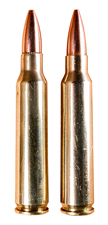
.223 Rem/5.56 Ammo
.223 Remington and 5.56 NATO are the standard cartridges of the AR-15 platform — the most popular rifle caliber in America by volume. The two are closely related but not identical, and understanding the difference matters before you load your rifle. Impact Guns carries .223 and 5.56 ammunition in every configuration from bulk steel-case practice to match-grade precision loads.
Read our full .223 / 5.56 Ammunition Buying Guide ↓
.223 / 5.56 Ammunition Buying Guide
.223 vs. 5.56 — What's the Difference
The key difference is chamber pressure: 5.56 NATO runs at higher pressure than SAAMI .223 Remington specifications. A rifle with a 5.56 NATO or .223 Wylde chamber can safely fire both .223 and 5.56 ammunition. A rifle with a .223 Remington chamber should only fire .223-spec loads — shooting 5.56 in a .223 chamber can produce higher-than-designed pressure. Most AR-15s sold today use a 5.56 or Wylde chamber that accepts both safely. Check your barrel's chamber marking before mixing ammunition types. When in doubt, .223 Remington commercial loads are safe in any chamber; 5.56 military-spec loads should only be fired in 5.56 or Wylde chambers.
M193 vs. M855: Military Spec Loads Explained
M193 is the original US military 5.56 load — a 55-grain FMJ at approximately 3,165 fps from a 20-inch barrel. It fragments reliably at velocities above about 2,700 fps, which limits effective range in short-barreled rifles. M193 is the best overall choice for general range use and home defense in 5.56 rifles. M855 (SS109) is a 62-grain steel-penetrator load developed to penetrate mild steel at range — it has a green-painted tip. M855 was designed for military use against light cover, not for terminal performance on soft targets. For home defense, M193 or purpose-designed expanding loads are better choices than M855. Both M193 and M855 are widely available in bulk quantities and are appropriate for range practice in any 5.56-chambered rifle.
FMJ and Steel-Case Practice Loads
For high-volume range practice, FMJ loads from Federal American Eagle, Winchester USA, Hornady Steel Match, and PMC Bronze offer reliable performance at reasonable prices. Steel-case 5.56/.223 from Wolf, Tula, and Hornady Steel Match is available at lower per-round cost and is appropriate for practice use — it runs reliably in most AR-15s though it produces more carbon buildup and more extractor wear than brass over many thousands of rounds. For semi-automatic practice, either works well. Buy in bulk — 1,000-round cases are the standard for regular AR-15 shooters and reduce per-round cost significantly.
Defensive and Home Defense Loads
For home defense in AR-15 platforms, purpose-designed expanding loads are preferred over FMJ. Federal Fusion MSR, Hornady TAP, Hornady Black (75gr BTHP), and Speer Gold Dot 64gr are well-regarded options. The key concern with 5.56 in home defense is over-penetration — FMJ .223/5.56 will pass through multiple interior walls. Expanding loads designed for terminal performance in the 5.56 caliber fragment reliably at typical AR-15 muzzle velocities and reduce over-penetration compared to FMJ. For short-barreled rifles (under 16 inches), choose loads specifically designed for barrier-blind performance at lower velocities. Verify function with your chosen defensive load in your specific rifle before relying on it.
Hunting Loads: .223 / 5.56 for Deer and Varmints
The .223/5.56 is a capable varmint and small game cartridge — prairie dogs, coyotes, foxes, and similar animals are well within its envelope. For deer and larger game, state regulations vary — several states prohibit .223 for deer due to minimum caliber or energy requirements. Where legal, controlled-expansion loads in 60–70 grain are the appropriate choice: Federal Fusion, Hornady CX, and Nosler Ballistic Tip provide reliable expansion on deer inside 200 yards from an AR-15. Verify your state's minimum caliber/energy requirements before hunting deer with .223.
Match and Precision Loads
For precision AR-15 and bolt-action work, Hornady ELD-M in 52 and 73 grain, Black Hills 77gr Sierra MatchKing, and Federal Gold Medal in 69gr SMK are among the most accurate factory loads available. Heavier bullets (69–77gr) perform better at longer ranges due to higher BC; lighter bullets (55–62gr) are adequate inside 300 yards. Heavier bullets require a faster twist rate to stabilize — most AR-15s with 1:8 or 1:7 twist handle 77-grain bullets well; 1:12 twist barrels are limited to 55 grains and lighter. Check your barrel's twist rate before investing in heavy-for-caliber match loads.
Buying in Bulk
.223/5.56 is one of the most cost-effective centerfire calibers to shoot in volume. Cases of 1,000 rounds are the standard bulk purchase for regular AR-15 shooters — per-round cost drops significantly at case quantities versus box pricing. Steel-case 1,000-round cases represent the lowest per-round cost available; brass-case Federal and Winchester offer better consistency for reloaders and precision use. Buying ahead of demand spikes — which historically occur during political events — is a sound approach for regular AR-15 shooters.
Shop .223 / 5.56 Ammo at Impact Guns
Browse the full .223 / 5.56 ammunition selection at Impact Guns. For the rifles that fire it, see our AR-15 rifles page. For related calibers, see .300 Blackout and 6.5 Creedmoor. For other rifle ammo, see our rifle ammo page.