
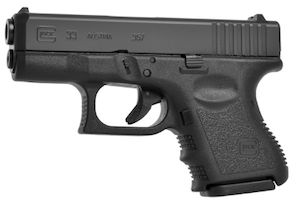
Glock 33
The Glock 33 is the subcompact .357 SIG pistol in Glock’s lineup—the smallest package Glock offers for the high-performance bottleneck cartridge. With a 9+1 capacity, 3.43″ barrel, and the same subcompact frame as the Glock 26 and Glock 27, the G33 is the choice for a shooter who demands .357 SIG terminal performance in a concealable platform and is willing to accept the tradeoffs of a subcompact high-pressure cartridge.
Read our full Glock 33 Buying Guide ↓
Why Choose the Glock 33 Over Other Subcompact Options?
The G33’s primary appeal is straightforward: it delivers .357 SIG ballistics in the most concealable Glock platform. From the 3.43″ barrel, a 125-grain .357 SIG load still achieves 1,250+ fps—meaningfully faster than 9mm or .40 S&W from the same barrel length, and delivering better barrier penetration than either. For a shooter who carries a primary .357 SIG duty gun (like the G31) and wants a backup or off-duty gun in the same caliber with magazine compatibility, the G33 makes the caliber ecosystem work. Glock 31 and 32 magazines can be used in the G33 as extended reloads, which is the same arrangement as the G26/27/33 subcompact family.
G33 vs. G27: Subcompact .357 SIG vs. .40 S&W
The G27 (.40 S&W) and G33 (.357 SIG) share the same subcompact frame and accept the same magazines for their respective calibers. A .357 SIG barrel drops into the G27 frame as a direct conversion since the magazines are compatible. This means a G27 owner can run both calibers with a simple barrel swap, which makes the standalone G33 less necessary unless .357 SIG is your only intended caliber. The G27 is the more common choice due to .40 S&W’s lower cost and broader ammunition availability; the G33 makes the most sense for dedicated .357 SIG shooters or those whose agency issues .357 SIG.
Recoil and Shootability in a Subcompact .357 SIG
The G33 is a challenging gun to shoot well. Full-power .357 SIG loads in a 23-oz subcompact produce significant recoil and muzzle blast—more than a G26 in 9mm and considerably more than most subcompact options. This is the primary practical limitation of the G33 for daily carry: follow-up shots require more deliberate technique and grip consistency than lighter-recoiling alternatives. Shooters who carry the G33 seriously should train regularly with full-power loads rather than downloaded .357 SIG, which misses the point of the cartridge. If high-volume range practice with reduced recoil is a priority, a 9mm conversion barrel and G26 magazines provide a more comfortable training option while keeping the G33’s grip familiarity.
Holster and Carry Options for the G33
The G33’s dimensions match the G26 and G27, so holsters marketed for those models generally fit the G33. This is a significant practical advantage—the G26/27/33 subcompact footprint has extensive holster support from Alien Gear, Galco, Safariland, and virtually every other major holster maker. IWB at 3–4 o’clock or appendix carry are both practical, as is pocket carry in a jacket given the G33’s compact dimensions. A flush 9-round magazine keeps the profile trim; the extended G31 magazine provides a full firing grip at the cost of a longer grip profile.
Is the G33 Still Relevant in 2026?
The G33 occupies a niche that has narrowed as modern 9mm ammunition has improved. The argument for .357 SIG over 9mm+P from a subcompact is less compelling today than it was in 1995, but remains valid for shooters who prioritize barrier penetration above all else or who are already committed to the .357 SIG ecosystem. For a shooter without a .357 SIG primary gun, the G33 is a hard sell compared to a G43 or G26 in 9mm. For a .357 SIG shooter who wants platform consistency between their duty gun and backup, the G33 remains the right choice.
Related Pages
Browse all Glock firearms, shop .357 SIG ammunition, or compare the full-size Glock 31 for more capacity in the same caliber.