
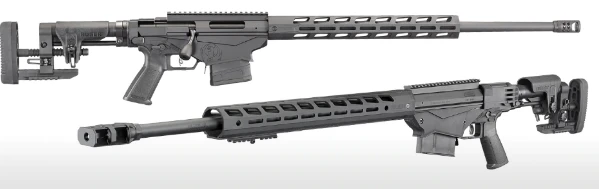
Ruger Precision Rifle
The Ruger Precision Rifle (RPR) redefined the entry-level precision rifle market when it launched in 2015 — delivering a folding stock, AICS-pattern detachable magazine, AR-style grip and trigger, and a cold hammer-forged barrel in a factory package at a price that undercut the competition by 30–50%. Today it remains the most popular precision bolt-action rifle for PRS competition entry and long-range hunting, available in 6.5 Creedmoor, .308 Win, 6mm Creedmoor, and .338 Lapua Magnum.
Read our full Ruger Precision Rifle Buying Guide ↓
RPR Caliber Options: 6.5 Creedmoor, .308, 6mm & .338 Lapua
6.5 Creedmoor is the most popular RPR caliber by a wide margin — the high-BC 6.5mm bullets retain velocity better than .308 Win at distance, with lower recoil and less wind drift. For PRS competition and long-range hunting to 1,000 yards, 6.5 Creedmoor is the right starting point. .308 Win offers the widest ammunition availability and lower cost per round — a practical choice for training volume. 6mm Creedmoor steps up ballistic performance over 6.5 for competition shooters who want the flattest possible trajectory. .338 Lapua extends the RPR platform to 1,500+ yard engagement capability for dedicated long-range work.
RPR vs. Tikka T3x TAC A1 vs. Savage 110 Precision: Comparison
The RPR competes directly with the Tikka T3x TAC A1 and Savage 110 Precision in the entry precision rifle segment. The Tikka offers superior factory trigger quality and legendary Tikka accuracy in a chassis-stocked package. The Savage 110 provides Savage’s AccuTrigger system and excellent value. The RPR’s advantages are the folding stock (critical for vehicle and pack transport), AICS magazine compatibility (the widest aftermarket magazine standard in precision rifles), and AR-familiar ergonomics. For PRS competitors who need maximum versatility, the RPR’s modularity wins. For pure accuracy and trigger quality, Tikka leads.
RPR Features: What Makes It Stand Out
Several RPR features set it apart from traditional bolt-action designs at its price. The folding stock reduces overall length by 5″ for transport — it locks open and doesn’t affect zero. The AICS-pattern magazines (5 and 10-round) are the competition standard, with aftermarket options from Accuracy International, Magpul, and MDT. The AR-compatible pistol grip accepts any AR-15 grip for personalized ergonomics. The Picatinny top rail and M-LOK handguard provide unlimited accessory mounting. The Ruger Marksman Adjustable trigger breaks cleanly between 2.25 and 5 lbs. These features in a factory rifle under $1,500 remain remarkable value.
RPR for PRS Competition: Getting Started
The Ruger Precision Rifle is the most recommended starting platform for Precision Rifle Series (PRS) competition — it arrives with the features competitors need (chassis stock, AICS mags, adjustable trigger) without requiring immediate upgrades to be competitive. A standard PRS build starts with the RPR in 6.5 Creedmoor, a quality scope in the 5–25x range (Vortex Razor, Leupold Mark 5HD, or similar), a bipod, and a rear bag. This setup competes effectively in Production and Tactical divisions. As skills develop, trigger upgrades, custom barrel work, and tuned ammunition become relevant — but the RPR gets new competitors to the line effectively.
Frequently Asked Questions: Ruger Precision Rifle
What is the Ruger Precision Rifle?
The Ruger Precision Rifle (RPR) is a bolt-action precision rifle designed from the ground up for long-range shooting competition (PRS, F-Class), military-style rifle matches, and hunting at extended ranges. It features an AR-style adjustable stock, AR-compatible pistol grip, a detachable AICS-compatible magazine, a folding stock mechanism, and a free-float M-LOK handguard — bringing the ergonomics of a chassis system rifle to a production price point.
What calibers does the Ruger Precision Rifle come in?
The RPR is available in 6mm Creedmoor, 6.5 Creedmoor, .308 Winchester, .338 Lapua Magnum, and .300 Winchester Magnum. The 6.5 Creedmoor is the most popular for PRS competition; the .308 is the most common for general precision use; the .338 Lapua is for extreme long-range work.
Is the Ruger Precision Rifle good for competition?
Yes — the RPR has become one of the most popular entry and mid-level PRS competition rifles. Its adjustable chassis ergonomics, AICS magazine compatibility, and factory accuracy performance deliver genuine competition capability at a price point well below custom precision rifles. Many PRS competitors run RPRs successfully at regional and national matches.
Does the RPR use AR-15 magazines?
The .308 and 6.5 Creedmoor RPR use AICS-pattern short-action magazines. The .338 Lapua and .300 Win Mag use AICS long-action magazines. The RPR does not use AR-15 magazines despite its AR-compatible pistol grip and stock.
See Also: Ruger Firearms • Bolt-Action Rifles • .308 Win Ammo • 6.5 Creedmoor Ammo • Scopes & Optics