
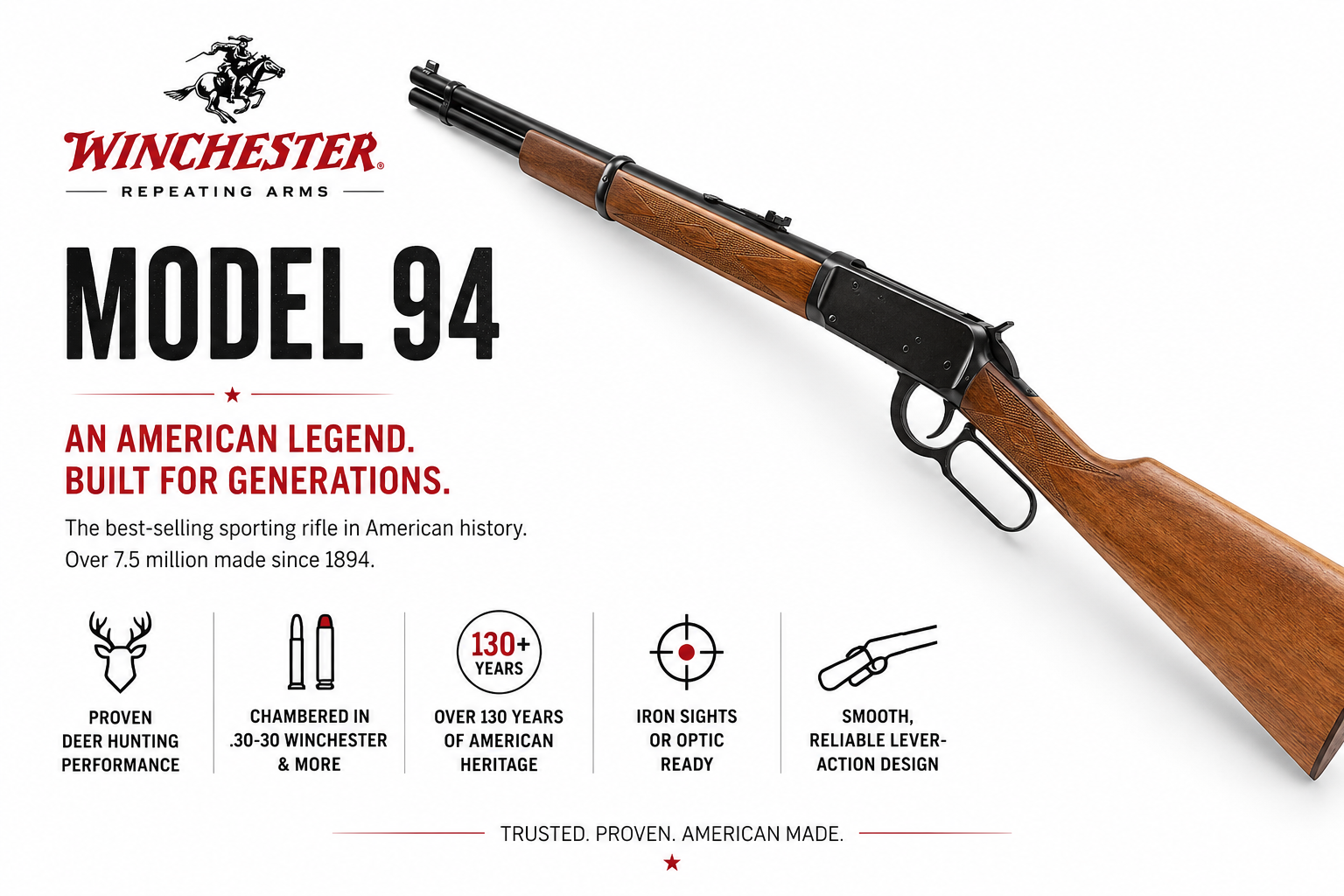
Winchester Model 94
The Winchester Model 94—originally designated the Model 1894 when John Browning designed it for Winchester’s catalog—is the best-selling sporting rifle in American history, with over 7.5 million produced since its introduction. Chambered primarily in .30-30 Winchester, the Model 94 became the defining deer hunting rifle of the 20th century and remains in production today in configurations spanning the classic 20-inch carbine to compact Trapper models and the Long Ranger variant with a detachable box magazine. The names “Model 94” and “Model 1894” refer to the same rifle; Winchester shortened the designation to “94” in everyday use while the full name appears on original catalogs and collector documentation.
Read our full Winchester Model 94 Buying Guide ↓
Model 94 vs. Marlin 336: America’s Two Great Lever-Action Rifles
The Winchester 94 and Marlin 336 have competed for the lever-action deer rifle market for over 125 years. The Winchester uses a top-eject action where spent cases exit from the top of the receiver, which historically prevented mounting a scope directly over the bore—the reason Lyman and others developed offset side mounts. The Marlin 336 uses a side-ejection action that allows conventional scope mounting. Modern Winchester 94 production includes an angle-eject variant that solves the scope-mounting issue entirely. For traditionalists who prefer iron sights, the original Winchester action is ideal; for scope users, the angle-eject model matches the Marlin’s convenience completely.
Current Winchester 94 Configurations
Winchester’s current Model 94 production spans several distinct configurations. The standard Carbine runs a 20-inch barrel with traditional walnut and a round forearm. The Short Rifle uses a straight-grip stock for a cleaner look. The Trapper model steps down to a 16-inch barrel for maximum compactness—a format that dates to the original 1894 catalog. The Long Ranger breaks from tradition with a detachable rotary box magazine that supports spitzer bullets in calibers including .308 Winchester and 6.5 Creedmoor, extending effective range well beyond what the tube magazine allows. Each configuration serves a distinct use case from dense-woods deer hunting to open-country use with the Long Ranger.
Pre-1964 vs. Post-1964 Winchester 94: The Quality Question
Winchester changed manufacturing processes in 1964 to reduce production costs, and the pre-1964 Model 94 has been prized by collectors ever since. Pre-’64 rifles feature hand-fitted parts, milled components, and a higher polish standard. Post-’64 production introduced more cast and stamped parts; quality improved significantly again under the current production era. For shooting use, modern production Model 94s are accurate, reliable, and well-finished. For collecting, a pre-’64 Winchester 94 in good condition commands a meaningful premium that reflects genuine craftsmanship differences. Most hunters shooting .30-30 deer country will never notice a functional difference; collectors care deeply about the distinction.
.30-30 Winchester: Still Relevant After 130 Years
The .30-30 Winchester, introduced alongside the Model 1894 in 1895, is estimated to have taken more whitetail deer than any other cartridge in history. At .30-30’s effective range of 150–200 yards, a 150-grain bullet delivers approximately 1,900 foot-pounds of energy—sufficient for deer, black bear, and feral hogs. The cartridge’s tube magazine requires flat-nosed or round-nosed bullets in standard loadings; Hornady’s LEVERevolution line with flexible polymer tips allows aerodynamic spitzer-style bullets without the safety concern of a pointed tip resting against a primer in the magazine. For hunters who shoot at moderate ranges in wooded or brushy country, the .30-30 remains completely effective and carries a historical character that no modern cartridge can replicate.
Winchester 94 for Collecting and Heritage Value
Few American firearms have the cultural resonance of the Winchester 94. It was the rifle carried by Theodore Roosevelt, popularized by the cowboy era, and became synonymous with the image of the American frontier. Factory special editions, commemorative models, and custom configurations have been produced throughout the rifle’s history, many of which now command significant collector premiums. For buyers interested in the Model 94 as a collector’s piece, original box, documentation, and original finish condition are the primary value drivers. For those buying as a functional hunting or ranch rifle, the current production models are the practical choice—the heritage is built into every one regardless of production era.
Frequently Asked Questions: Winchester Model 94 / 1894
What is the Winchester Model 1894?
The Winchester Model 1894 is one of the most historically significant firearms ever produced — a John Moses Browning-designed lever-action rifle that has been in production in various forms since 1894, making it the longest continuously produced sporting rifle in history. Chambered primarily in .30-30 Winchester (a cartridge also introduced in 1894), the Model 94 defined American deer hunting for over a century.
Who makes the Winchester Model 94 today?
The Winchester Model 94 is currently produced by Winchester Repeating Arms, which is owned by the Olin Corporation. Production was moved to Miroku in Japan (under license) after the original New Haven, Connecticut factory closed in 2006. Current production Winchester 94s are well-regarded for their quality.
What calibers does the Winchester Model 94 come in?
The Model 94 is available in .30-30 Winchester, .38-55 Winchester, .450 Marlin, and .357 Magnum in various configurations. The .30-30 remains the standard and most available caliber, with the .357 Magnum Trapper variant being popular for its pistol-caliber versatility.
What is the difference between the Winchester 94 and Marlin 336?
Both are .30-30 lever-action deer rifles but with different action designs. The Winchester 94 ejects cartridges from the top of the receiver, which traditionally prevented scope mounting directly over the bore (though side-mount and angle-eject versions address this). The Marlin 336 ejects from the side, allowing straightforward scope mounting. The Winchester 94 has a slimmer, lighter profile; the Marlin 336 is slightly heavier with a more robust action.
See Also: Winchester Firearms • Marlin 336 • Lever-Action Rifles • .30-30 Ammo • Hunting Rifles