
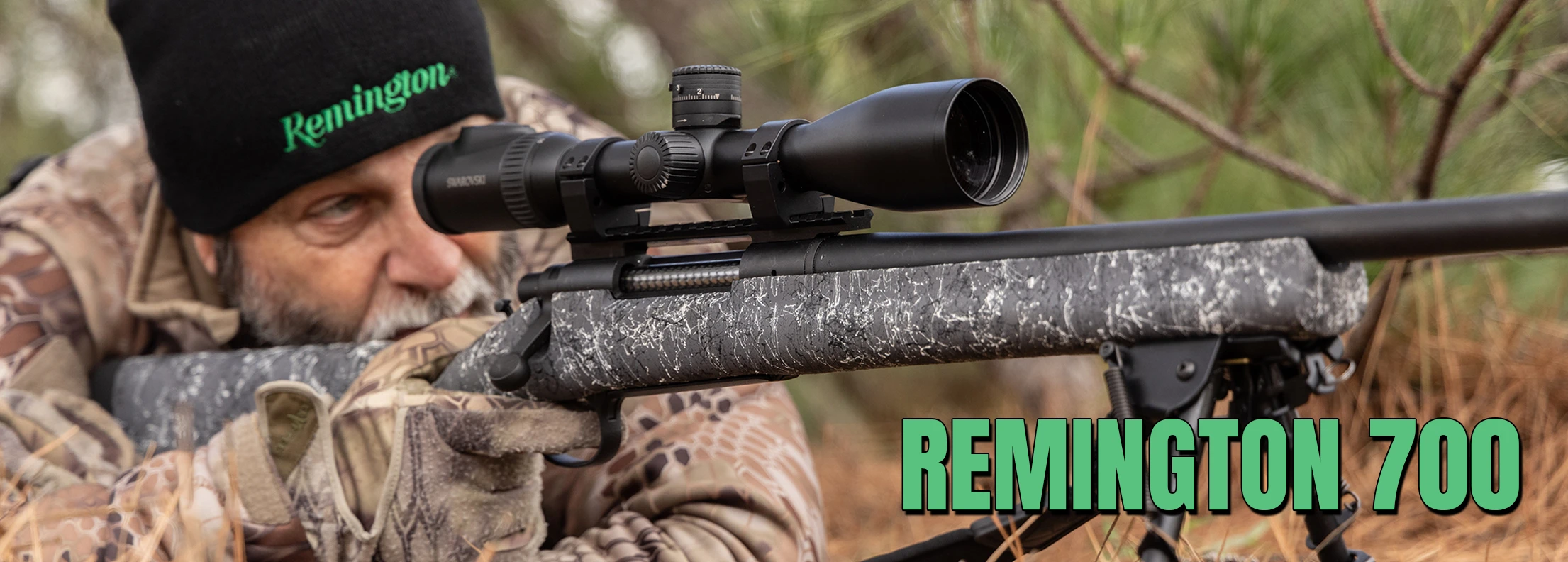
Remington 700
The Remington Model 700 is the most widely used bolt-action rifle in American history — the platform behind more U.S. military and law enforcement sniper rifles than any other, and the benchmark by which civilian bolt-actions have been judged since 1962. With a push-feed action machined to tight tolerances, a trigger that’s adjustable right out of the box on modern variants, and a receiver footprint that has spawned the largest aftermarket ecosystem in the bolt-action world, the 700 remains the logical starting point for any serious bolt-action purchase.
Read our full Remington Model 700 Buying Guide ↓
Model 700 ADL vs. BDL vs. SPS: What’s the Difference?
The ADL (Average Deluxe) is Remington’s entry-level 700 configuration — a blind magazine (no floorplate), synthetic stock, and matte finish, often packaged with a scope. It’s the best value in the 700 lineup and the right choice for hunters who want a capable rifle without paying for features they’ll never use. The BDL (Better Deluxe) adds a hinged floorplate for easy unloading and a higher-grade finish. The SPS (Special Purpose Synthetic) bridges the gap with a rugged matte black finish optimized for field use. All three share the same legendary 700 action.
Caliber Options: 6.5 Creedmoor, .308, and .300 Win Mag
The Model 700 is chambered in more calibers than almost any other bolt-action, but the most popular modern choices cluster around three: 6.5 Creedmoor for its outstanding long-range ballistics and mild recoil, .308 Winchester for its widespread ammunition availability and proven hunting versatility, and .300 Winchester Magnum for hunters who need more downrange energy for large or dangerous game. The 700 ADL in 6.5 Creedmoor is one of the most popular entry-level precision packages on the market today, and a common starting point for new long-range shooters.
The 700 as a Precision Rifle Platform
The Model 700’s greatest strength beyond its out-of-the-box accuracy is its aftermarket depth. The 700 footprint is the most common chassis and stock inlet in the industry — Magpul, MDT, Chassis Systems, and dozens of other manufacturers build specifically around it. Triggers from Timney, Jewell, and TriggerTech drop directly in. The bolt face and action dimensions are so well-documented that gunsmiths can rechamber, rebarrel, and reconfigure a 700 faster and cheaper than almost any other bolt-action. This makes it uniquely upgradeable as your shooting skills develop.
700 PCR and Tactical Variants
The 700 PCR (Precision Chassis Rifle) is Remington’s factory answer to the growing precision rifle segment. It ships in a folding MDT chassis, with a threaded barrel, adjustable cheek piece, and an oversized bolt knob — essentially a factory-built precision setup that previously required thousands of dollars in aftermarket work. The 700 Tactical variants used by military and law enforcement have the same action geometry, which means government-surplus techniques and training directly translate to civilian ownership. For competitive precision rifle shooting, the 700 PCR is one of the most competitive platforms at its price point.
Remington 700 vs. the Competition
The 700’s main competition in the bolt-action market comes from the Tikka T3x, Savage 110, and Bergara B-14 — all of which offer competitive accuracy and features. The Tikka wins on out-of-the-box trigger feel and slick bolt operation; the Savage offers more caliber flexibility; the Bergara punches above its price in barrel quality. The 700’s decisive advantage is the aftermarket: no other bolt-action has as large or as mature an ecosystem of stocks, chassis, barrels, and triggers. If you plan to upgrade your rifle over time, the 700 is still the platform that gives you the most options.
Frequently Asked Questions: Remington Model 700
Why is the Remington 700 so popular?
The Remington Model 700 has been in production since 1962 and is the most widely produced bolt-action rifle in American history, with over five million made. Its push-feed action with three-position safety, free-floated barrel, and consistent accuracy made it the US military’s M24 and M40 sniper rifle platform, and its unparalleled aftermarket support — more stocks, triggers, and accessories than any other bolt-action — makes it the dominant platform for custom precision rifle building.
What is the difference between the 700 ADL and BDL?
The ADL (Average Deluxe) has a blind internal magazine with a floor plate that doesn’t open. The BDL (Better Deluxe) has a hinged floor plate that opens for quick unloading. The BDL also has higher-grade wood and a more polished finish. For practical hunting use, the BDL’s hinged floor plate is a meaningful convenience; the ADL is the more common and affordable configuration.
Is Remington still making the Model 700?
Yes. Remington was acquired by Vista Outdoor in 2020 following bankruptcy and production resumed at a new facility in LaGrange, Georgia. Current Remington 700 production has received generally positive reviews for quality comparable to pre-bankruptcy production.
What calibers does the Remington 700 come in?
The 700 is available in an exceptionally broad range of calibers from .204 Ruger through .416 Remington Magnum, covering virtually every hunting and precision shooting application. The most popular configurations include .308 Winchester, .30-06, 6.5 Creedmoor, .270 Winchester, and 7mm Remington Magnum.
See Also: Remington Firearms • Winchester Model 70 • Bolt-Action Rifles • Hunting Rifles • .308 Win Ammo