
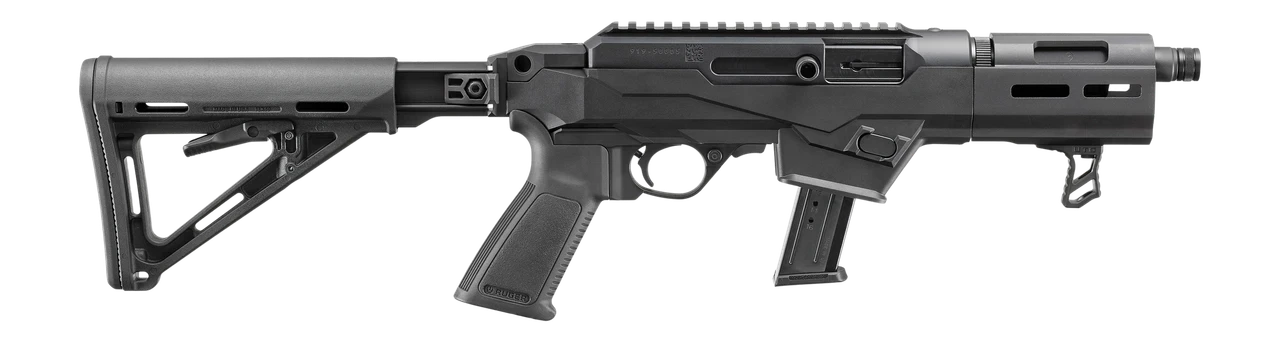
Short Barrel Rifles
Short barreled rifles (SBRs) are rifles with a barrel under 16”. The $200 NFA tax on SBRs is now $0, and on October 9, 2026 the ATF announced it no longer requires its approval or registration for them. You still pass a background check and a Form 4473, and state laws still apply. Impact Guns stocks SBR-configured rifles and large-format pistols from Sig Sauer, Daniel Defense, Ruger, and other top manufacturers. Talk to your dealer before you order so you both know the current steps.
Read our full Short Barreled Rifle Buying Guide ↓
What Is an SBR? Legal Definition and Appeal
A short barreled rifle (SBR) is legally defined as a rifle with a barrel length under 16” or an overall length under 26”. SBRs were regulated under the National Firearms Act. The appeal is straightforward: a shorter barrel produces a more maneuverable firearm in close quarters, vehicles, and confined spaces without sacrificing the rifle’s operating system, sight radius, or ability to accept rifle-length accessories. A 10–12” barrel AR-15 SBR is dramatically more compact than a standard 16” rifle while retaining full-power 5.56 performance at relevant engagement distances.
What Changed in 2026: No Tax Stamp, No ATF Approval
For decades, an SBR transfer required a $200 NFA tax stamp in addition to the firearm’s purchase price. Congress cut that tax to $0 in a law signed in July 2025, effective January 1, 2026. On October 9, 2026, the ATF published an open letter saying it no longer requires its approval or registration for SBRs. The ATF still accepts the old forms on a voluntary basis, and machine guns and destructive devices are not affected. For a plain-language summary, read our article ATF NFA Update: What Changes for Suppressors and SBRs.
What Has Not Changed
Every buyer still passes a background check and fills out a Form 4473. State and local laws are unchanged, and some states ban or restrict SBRs. The ATF letter also says a separate federal rule on dealer sales of SBRs and SBSs was not changed by the court order, and that the ATF is writing new rules for it. That is one more reason to ask your dealer how they handle SBR sales before you order.
SBR vs. Pistol: Understanding the Difference
Many buyers encounter “pistol-configured” AR-15s and wonder how they differ from SBRs. The key distinction is the firearm’s classification. An SBR is a rifle-receiver firearm with a barrel under 16”. A pistol is built and sold as a pistol. SBRs can have a standard rifle stock and can also be suppressed. The two are classified differently, so do not swap parts between a pistol and a rifle without asking a qualified attorney first.
Popular SBR Platforms
The AR-15 in 5.56 NATO or .300 Blackout is the dominant SBR platform, with barrel lengths from 7” to 14.5” available across manufacturers. The .300 Blackout is particularly well-suited to SBR use — it was designed specifically for short barrels and produces excellent performance suppressed with subsonic ammunition. The Sig MCX Spear LT, Daniel Defense DDM4 PDW, and HK416 are purpose-built SBR-format platforms from top-tier manufacturers. AK-pattern SBRs including the Draco series configured as SBRs rather than pistols gain the ability to accept a traditional folding stock. Impact Guns can advise on the best SBR configuration for your intended use.
How to Buy an SBR in 2026
Select your firearm and order it from Impact Guns. Your SBR goes to a licensed dealer, who completes the sale with you. At pickup you fill out a Form 4473 and pass a federal background check, just as you would for any firearm. Contact your dealer first to confirm they are up to date on the October 2026 changes and to ask about their steps and fees. For a related walkthrough, see our guide, How to Buy a Suppressor.
SBRs and Suppressors
Many SBR owners add a suppressor. A short barrel produces more muzzle blast, so many owners pair the two, and hearing protection is still important. Both items follow the same changes: no tax stamp, and no ATF approval or registration. Browse our full suppressors for sale for compatible options.
Frequently Asked Questions: Short-Barrel Rifles
Should I talk to my dealer first?
Yes. These changes are new, and your dealer may still be updating their process. Contact your dealer before you order. Ask which steps and forms they use, what fees they charge, and what your state allows.
What qualifies as a short-barrel rifle?
A short-barrel rifle (SBR) under the National Firearms Act is a rifle with a barrel shorter than 16 inches or an overall length under 26 inches. The $200 NFA tax on SBRs is now $0, and the ATF no longer requires approval or registration for them. A pistol is classified differently from an SBR.
What is the process to buy an SBR?
Choose your firearm, order it, and complete the Form 4473 and a federal background check at pickup. Contact your dealer first, since dealer sales of SBRs are covered by rules the ATF is still writing. The ATF still accepts Form 1, Form 3 and Form 4 applications on a voluntary basis, so filing is your choice.
Can I take my SBR to another state?
Only to states that allow SBRs. Some states prohibit SBR ownership, and state and local laws are not changed by the ATF letter. The ATF letter says people who transport SBRs across state lines should keep filing Form 20. Verify the laws in any state you plan to visit before you travel.
What states prohibit SBRs?
As of 2026, California, New York, New Jersey, Maryland, Massachusetts, Hawaii, and a small number of other states prohibit or heavily restrict civilian SBR ownership. Always verify current state law before you buy.
Is an AR pistol better than an SBR?
It depends on how you plan to use it. SBRs can take a traditional rifle stock, which is generally more comfortable for shouldered firing. A pistol is classified differently, and some states treat the two differently. Ask your dealer and check your state law before you choose.
See Also: Suppressors • AR-15 Rifles • How to Buy a Suppressor • ATF NFA Update • Short-Barrel Shotguns